









On February 26, 2019, the people of Toledo, Ohio did something that had never been done before in the history of the United States. They voted to give Lake Erie legal rights. Not regulatory protections or pollution thresholds—rights. The right to exist. The right to flourish. The right to naturally evolve. Over 60 percent of Toledo voters said yes.
One year and one day later, a federal judge struck it down.
That is the story of the Lake Erie Bill of Rights—known as LEBOR—and it is one of the most important legal battles in the history of the Great Lakes Basin region, and the United States, and most people have never heard of it.
I sat down again with Tish O’Dell and Ben Price, two Community Rights Pioneers with the Community Environmental Legal Defense Fund (CELDF), to walk through what LEBOR actually said, how it came to be, what happened to it, and why it still matters even though it is no longer law.
Because here is the thing about LEBOR: Even in defeat, it changed everything.
What LEBOR Actually Said
Before we get into the politics and the legal battle, it is worth sitting with the actual language of the bill. Because when you read it, your first reaction is probably going to be the same as mine: this is common sense. Why would anyone fight this?
The bill opens with a declaration from the people of Toledo: that the laws ostensibly enacted to protect them and foster their health, prosperity and fundamental rights do neither. That the very air, land and water on which their lives and happiness depend are threatened. And that it has, therefore, become necessary to reclaim, reaffirm and assert their inherent and inalienable rights—and to extend legal rights to their natural environment—so that the natural world is no longer subordinated to the accumulation of surplus wealth and unaccountable political power.
That is not radical language. That is a community saying: the system that was supposed to protect us is not protecting us, so we are going to change it.
The bill enumerated three specific rights: First, the Lake Erie ecosystem—including all natural water features, communities of organisms, soil, and terrestrial and aquatic sub-ecosystems—shall possess the right to exist, flourish and naturally evolve. Second, the people of Toledo possess the right to a clean and healthy Lake Erie and Lake Erie ecosystem. Third, the people of Toledo possess both a collective and individual right to self-government in their local community. Again, where is the controversy? All common sense, right?
The bill also addressed enforcement directly. The Lake Erie ecosystem could enforce its rights through legal action brought in its name as the real party in interest, prosecuted by either the city or a resident. Damages would be measured by the cost of restoring the ecosystem to its status before the harm occurred. And corporations that violated or sought to violate the law would not be deemed persons to the extent that such treatment would interfere with the rights enumerated in the bill.
That last piece—stripping corporate personhood within the context of this law—is what made the powerful very, very nervous, and suddenly, defending the ecosystems that all life depend on to survive, including humans, became very controversial.
How It Started: A Toxic Summer and a Bar Napkin
To understand why Toledo passed this bill, you have to go back to August of 2014.
Residents woke up to warnings across every television, computer, and radio in the region. Do not drink the water. Do not touch the water. Do not shower in the water. Do not do your dishes in the water. Do not do your laundry in the water. This was not a boil alert. You could not boil this away. Toxic algae had gotten into the city’s water intake, and the microcystin—a cyanobacterial toxin now being studied for links to ALS and Parkinson’s disease—had contaminated the entire supply.
Bottled water flew off the shelves. People drove over a hundred miles to find water. I watched one CELDF testimony of a woman who was pregnant at the time and experiencing contractions, stating that she had to drive over 100 miles to find water. Businesses and restaurants shut down. The hospital scaled back to emergency operations only. In August, the hottest part of the year, Toledo had no usable water for over three days. Think of how difficult it would be to have no usable water for over three days.
This 2014 algae bloom was not even the largest one Lake Erie had seen. The 2013 bloom was bigger. But this was the one that got into the water intake. What makes this whole thing even more disheartening is that the cause of algae blooms was not a mystery. The massive corporate industrial agriculture system operating throughout northwest Ohio—huge farms growing soybeans and corn for industrial uses, enormous animal feeding operations—was spraying crops with pesticides and herbicides loaded with phosphorus and nitrogen. That runoff traveled through streams and rivers directly into Lake Erie. Everyone knew it. The state had already spent significant money monitoring and testing it. They knew exactly where it was coming from. And yet, they kept issuing permits for more of it to continue.

From 2014 to 2018, Toledo residents did what we are all taught to do. They went to their elected officials. They did research. They pushed for more regulations and better monitoring. They were told they needed a new water treatment plant—and that they, the residents, would have to pay for it. Nature itself was even blamed. It was the wind that blew the algae into the intake. Let’s just completely ignore the fact that the algae exists in toxic form to begin with, shall we?
After three years of working within a system that was not working, some of those residents ended up at a CELDF presentation at Bowling Green University. They were frustrated. They were angry. They were asking: is this going to happen again? Because nothing is stopping it.
After the presentation, they approached Tish O’Dell and asked whether Rights of Nature could work to protect Lake Erie. They went to a pub that night and talked it through at length. The first draft of the Lake Erie Bill of Rights was written that night—on a bar napkin.
Tish O’Dell wishes she still had that napkin. So do I because it was history in the making.
What Happened the Moment It Passed
In February 2019, LEBOR went on a special election ballot. Even getting it there required a court battle. There were attempts to keep it off the ballot entirely. But it did make it. And over 60 percent of Toledo voters approved it.
Tish O’Dell was in her hotel room the morning after the election when her phone rang. A reporter was calling to ask what she thought about the lawsuit. She had gone to bed happy, celebrating. She had no idea what he was talking about.
Within twelve hours of passage, a corporate agricultural entity—Drewes Farms Partnership (pronounced Draves)—filed a federal lawsuit to have LEBOR overturned. Drewes Farms did not even operate within the city of Toledo, but clearly, their industrial agricultural runoff flowed freely into Lake Erie and its watersheds.
Fair warning: the next part of the story is a bit infuriating but it perfectly illustrates what We the People are up against. The case went to court. When CELDF and the community members who had actually drafted the law tried to intervene in the case—to be part of their own legal defense—the judge denied them. Yes, you read that correctly. The judge denied their legal defense in the case. At the same time, the State of Ohio filed a motion to intervene in the lawsuit on the side of the polluter. The judge allowed it.
The people who passed the law were locked out of the courtroom. The state that had been issuing permits for the pollution that poisoned Toledo’s water in the first place was allowed in—on the side of the corporation suing to overturn protections against that very pollution.
If that sounds absurd to you, it should. Because it is. This is corporate personhood usurping actual personhood. It’s also a state government defending corporate personhood over actual persons of their state—their constituents. I’d say Ohio should be ashamed, but their behavior is more of a rule than an exception.
One Year and One Day
On February 27, 2020—one year and one day after LEBOR passed—federal judge Jack Zouhary struck it down.
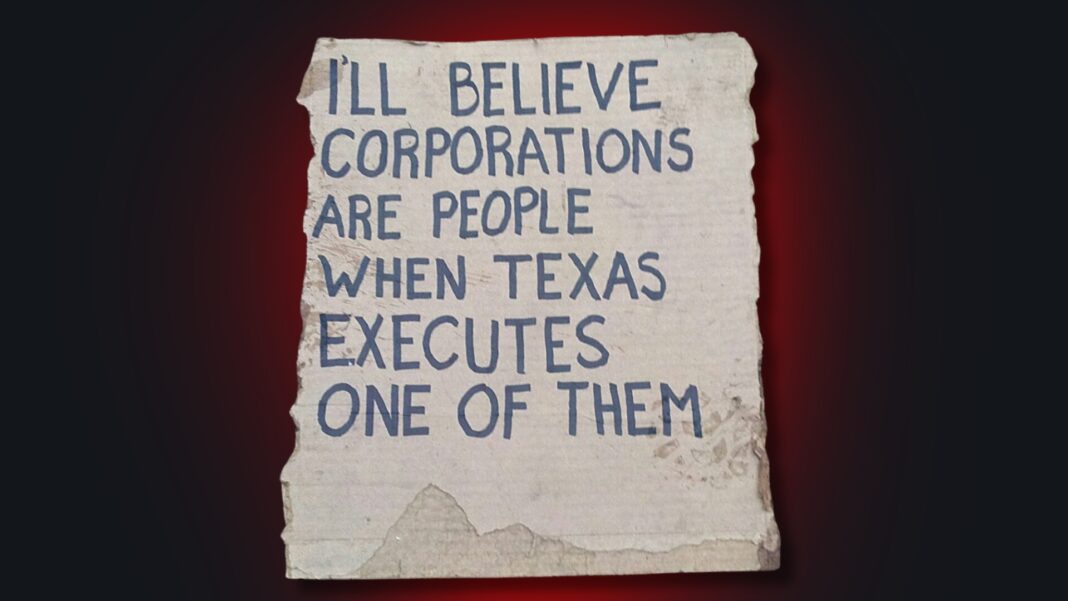
The court ruled on two primary grounds. First, that LEBOR violated the due process clause of the 14th Amendment, the amendment ratified after the Civil War to protect the rights of freed slaves, guaranteeing equal protection under the law. The court held that this due process protection extended to corporate persons. Not the people of Toledo. The corporation that was suing them.
Second, the court ruled that Toledo, as a municipal subdivision of the state of Ohio, had exceeded its authority by enacting a law that recognized rights the state had not granted.
In plain language: the democratic decision of over 60 percent of Toledo voters was overturned because it might interfere with the rights of a corporation that did not even operate in Toledo. The permit to pollute was more legally defensible than the community’s right to clean water. And Toledo was stripped of its right for its citizens to self-govern.
Ben Price puts it plainly: we don’t regulate murder. We don’t say there’s money in assassination so we’ll allow it within certain thresholds. We don’t regulate things that do absolute harm and violate rights, unless it’s a corporation. LEBOR was a law that would have corrected that. And the entire legal system—all three branches, as the Ohio State Law Journal later documented—said no.
The arguments made in that courtroom were something else entirely. On one hand, corporate and state attorneys argued that LEBOR was merely “aspirational” language—poetry, essentially. On the other hand, those same attorneys argued how dangerous and harmful the law would be to the agricultural industry. Tish O’Dell, who was present for nearly an hour of back-and-forth arguments, put the contradiction perfectly: which is it? Is it just poetry, or does it have enough teeth to be threatening?
The answer, of course, is both. It was threatening precisely because it meant something. And if you were not poisoning the Lake, you would have had nothing to fear from a law that said you could not poison the Lake.
The Money and the Backroom Deal
After LEBOR was struck down, more of the story came to light.
The community group that drafted and campaigned for LEBOR spent approximately $5,500 to get it on the ballot and to pass it. The opposition spent over $300,000—money that was traced back to BP, among others, funneled through a consultant connected to Dick Cheney’s (former Vice President under George W. Bush) daughter in Virginia. BP operates a large refinery near Toledo. Of course they had significant concerns about a law that said you could not poison the water.
And then, through public records requests, another piece of the story emerged. In May 2019—just months after LEBOR passed—language was quietly inserted into the Ohio state budget bill the night before the vote. Preemption. The language inserted preempted any further Rights of Nature attempts statewide. No community could recognize the rights of nature. No ecosystem could have legal standing in court, which means, neither could humans against those who poison them.
The Ohio Chamber of Commerce drafted the language and handed it to a legislator to slip into a several-thousand-page budget bill. Most of the legislators who voted on that budget did not even know it was in there.
That is how afraid the system is of humans and nature having rights. Backroom deals are made to preempt them from happening.
Why LEBOR Still Matters
LEBOR is not law today. But its impact is impossible to overstate.
It was the first Rights of Nature law in United States history to recognize legally enforceable rights for a specific ecosystem. It was the first time Rights of Nature was argued in a federal court. It was covered by big players here in the United State such as Smithsonian, NPR, the New York Times, and more. The Daily Show even did a skit on it. Media outlets in France, Italy, Germany, Canada, India, and Australia also ran stories. Academics are still writing about it today.
As Tish O’Dell reinforces, what LEBOR proved—even in defeat—is that the current legal system is not broken. It is working exactly as it was designed. And it is designed to protect corporate property rights over community rights, over democratic decisions, and over the living ecosystems we depend on to survive. Against us humans.
LEBOR made that visible in a way that thirty years of CELDF advocacy could not fully accomplish on its own.
You can tell people how the system works. But when a federal judge strikes down the democratic vote of 60 percent of a city’s residents because a corporation from outside that city sued to protect its right to pollute, the evidence speaks for itself.
The genie, as Tish O’Dell puts it, is out of the bottle. And they cannot put it back. Indeed it is, and indeed they cannot.
Since LEBOR, Rights of Nature legislation has been introduced in New York State—which we covered in depth in episode three—as well as North Carolina and Minnesota. Groups in Cincinnati are working on protections for the Ohio River despite the state preemption law. A group in Columbus is circulating a petition to protect their city charter from state preemption entirely. Washington state has organizers working on it. Michigan has conversations beginning, and the rest of the Great Lakes Basin states will soon follow.
Florida, Utah, and potentially Wisconsin have passed or are pursuing preemption laws of their own. Industry knows what is coming. That is why they are trying to get ahead of it. Don’t let it scare you. It can be overcome.
If the Lake Could Speak
I ended our conversation with a question I have been sitting with since episode one. If Lake Erie could speak, what would she say?
Ben Price laughed and said he did not want to put words in the Lake’s mouth. But if he were the Lake, he thinks she would say: get over yourselves, humans. You have not been around as long as we have, and you will not be around as long afterwards. Drink some clean water instead of the contaminated mess you have created.
Tish O’Dell reminded me that she always refers to the Lakes as she, not it. To call nature it is to objectify it, and it is far easier to harm and destroy something when you have reduced it to an object. She believes the Lake would say thank you to everyone attempting to emancipate her. And she would say: do not give up. Because what you do to me, you do to yourselves.
That is where we are. That is what is at stake.
Lake Erie had rights for one year and one day. The question now is whether the rest of the Great Lakes Basin region is going to fight to make sure that never has to be the story again.
If you were moved by this, please support independent media free from corporate influence and fully defending the Great Lakes Basin region. Links below.
Watch Rights of the Lakes Episode 2 below.Episodes 1 and 3 are also available. Be sure to Subscribe, Like, and Share to help us reach more people.