




When someone loses their home, it doesn’t usually happen all at once. It doesn’t happen with a knock on the door followed by a dramatic eviction scene. It starts slowly. Usually, with a letter. Or in the case of mobile home parks, it starts with a notice taped to a community bulleting board, or slipped into a mailbox. A new owner. A new name. A clean logo. It may include language about “professional management” or “operational improvements.” Nothing that sounds alarming, at least not at first.
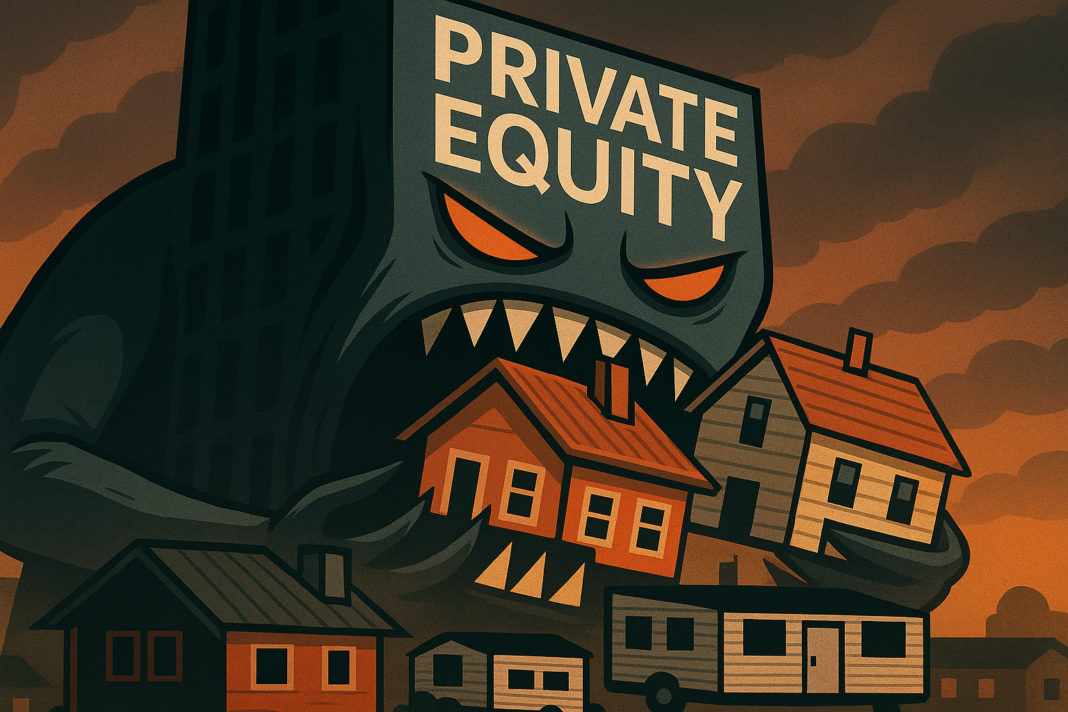
Across the Great Lakes Basin and the country, mobile home parks (also known as manufactured housing communities) are being quietly bought up by private equity firms, hedge funds, and real estate investment trusts (REITs) at an alarming rate.
Here in Michigan, 192 parks have been gobbled up by a number of these firms, and the pace has rapidly increased over the past few years. If you don’t live in one of these communities, you may not be aware that it’s happening. If you do, you feel it almost immediately.
When one of these firms takes over, they don’t arrive with bulldozers. They arrive with spreadsheets. They show up as shell companies with layered ownership structures, and they are designed to extract as much value as possible while absorbing as little responsibility as possible—including not taking responsibility for regulations to protect public health that are already on the books. And once ownership is finalized, everything starts to change—deliberately and predictably.
The first changes are usually framed as “updates.” A new billing system is introduced along with a new payment portal or rules. Then the rent begins to increase. It’s usually incremental. Fifty dollars here. Seventy-five dollars there. Sometimes it’s paired with new fees for water, trash, or “infrastructure improvements” that don’t ever seem to happen. Grace periods start to shrink. Late fees start to increase. All flexibility disappears. And before you know it, what used be $200 per month in lot rent now falls somewhere between $800 to over $1200 in some instances. Just to have the home you own sit on a pad of cement, or sometimes, just a pad of dirt.
At the same time, maintenance requests start to stall. The roads deteriorate and the sewage system begins to fail. Mold spreads. Electrical issues linger. Clean water—and sometimes access to any water at all—becomes an issue. Residents attempt to fix what they can themselves, not because it’s their responsibility, but because they feel as if waiting isn’t an option because they are living in unbearable conditions.
All of this unfolds under the inescapable reality that these residents may own their homes, but they do not own the land beneath them. And that’s the excuse they always hear when they complain to municipal services. ‘It’s private property. There’s nothing we can do,’ regardless of the public health crisis that many of these parks create.
This imbalance is both the leverage and the pressure point private equity and the others relies on. Mobile home residents are often treated as transient, as if this instability created by private equity is a personal choice rather than a condition imposed on them. In reality, these are deeply rooted communities: elderly retired residents, disabled residents, working families—people who chose mobile homes because they were one of the last remaining paths to stable, affordable housing. But stability becomes fragile when ownership changes into the hands of these “extraction” firms.
Eviction often comes as an impossible choice. I have heard story after story with the same narrative: pay the increase or fall behind, accept unsafe conditions or risk retaliation, speak up and risk being labeled “difficult.” And people fall in line because they are afraid to lose what they have. The cost to move a mobile home is upwards of $20,000. And if the resident doesn’t own their own land, they would likely be moving right back into a similar scenario at a different park. This is what happens when human lives become line items on a spreadsheet.
When landowners are incentivized to extract profit without reinvesting in the community, neglect and harm becomes normalized and suffering is treated as collateral damage.
And the damage doesn’t stay contained within the park. When a mobile home park destabilizes, entire communities feel it. Schools lose students. Local businesses lose customers. Municipal services are strained as families fall into crisis. Health outcomes decline. Emergency and medical calls increase. Neighborhoods fray and deteriorate. And when they inevitably do, they are labeled with unfair stigmas.
And what happens when this option of affordable housing begins to disappear and pushes people out? When people leave, they don’t magically land somewhere better. They double up by moving in with reluctant family. Elderly are pushed to nursing homes. Others couch-surf or end up in shelters. People lose everything they’ve ever worked for as they fall into becoming a statistic.
There’s also a hit to the local economy that rarely gets attention outside of stigmas. When one of these investment firms owns the mobile home park with the sole goal to extract the value vs a local family run small business, lot rent money stops circulating locally. Instead of being spent to uphold a local economy, it is extracted and funneled to distant and invisible investors. This is how community wealth-building evaporates and generational wealth dies. What was once a modest but stable ecosystem, becomes a drain.
The sad reality of what is happening is that state and local laws allow it. In many states across the Great Lakes Basin, mobile home parks are treated like ordinary real estate assets, despite functioning as a unique and vulnerable form of housing and home ownership. Lot rent increases face few, if any, limits. Maintenance standards are weakly enforced, if at all—even when public health regulations are on the books. Oversight is fragmented, if not completely absent. Accountability dissolves across jurisdictions and bureaucracy. And just try to find a lawyer to be on the side of the resident. All the money is in defending the billion dollar portfolios. Trust me, we’ve called many. Even those we received referrals to never returned our calls.
Private equity understands these gaps intimately. They exploit them because they exist and they can. We’ve spoken with residents who haven’t slept through the night in months because sewage odors fill their homes. Others who must choose between rent and medication. Elders terrified of losing the only home they’ve ever known for the past 30 years—that they’ve worked their whole lives to build.

Their stories aren’t dramatic for effect. They’re dramatic because the stakes are survival. Earlier this summer, we were introduced to this madness through two podcasts with residents or two organizations working to help them. Manufactured Housing Action (MH Action) and Family Promise of Western Michigan. You can listen the podcasts here: Part 1 and Part 2.
All of this led us to a woman and her family in Romulus, Michigan who is living a reality no one should be living in the world’s wealthiest nation. No one should be living the reality of being part of anyone’s investment portfolio, but Cynara’s situation is beyond the pale. Through our frustration and rage, we decided to take on her fight.
Over the past seven months, Cynara has been living in a mobile home she owns while it sits in a lake of raw sewage. The sewage has pooled beneath and around her home, slowly rotting it from the outside in. It is not only destroying her home, but also her health and the health of her daughter and grandson, who live with her.
She has complained. We have complained. And still, she remains there.
We’re fighting for the city and the state to enforce the regulations already on the books against the park owner, Sun Communities. We’ve involved state and federal representatives. We’ve contacted the mayor, city officials, and regulatory agencies. Formal complaints have been filed. Documentation along with photos and videos has been submitted.
And still, her home sits in sewage—filled with toxic fumes and overtaken by mold that continues to spread through the walls and floors.
We have contacted every legal aid service, housing program, and emergency assistance resource we could find, trying to get Cynara and her family into safe transitional housing while we fight the park ownership. There is no help. We’ve hit brick wall after brick wall. So we did the only thing left to us.
We set up our own foundation initiative and a GoFundMe to get Cynara and her family out—because no one should be forced to choose between staying in a poisoned home or becoming homeless. You can watch the video documenting what we found below, and help us move her family to safety while we continue this fight through the gofundme we’ve set up.
I cannot stress enough how this situation affects all of us. Mobile home parks were once framed as an affordable way to homeownership—the entry to it. A way to build stability. That promise is being stripped away, park by park, by bad actors who see homes not as shelters and a human right and an essential part of liberty, but as a part of their portfolio.
This is not a fringe issue. It is not isolated. These same firms are coming after everything. Single family homes. Apartment buildings. Mortgages. Small businesses of every shape and size. And we’ve all heard about what private equity has done to the like of Toys R’ Us, Joann Fabrics, and others. And it’s just the beginning. Mobile home communities are but a chapter in a much larger story. One we can no longer afford to look away from. You can follow the Private Equity Stakeholder Project to keep up to date on how private equity is changing the entire landscape of life in the United States and beyond.
Watch for our three part series coming soon on how private equity is affecting the landscape of the Great Lakes Basin Region and wrecking local economies, suffocating entrepreneurship, and destroying livelihoods.
Please consider supporting our Keep Our Homes Initiative so we can help more people like Cynara and work to help hold private equity, hedge funds, and REITs accountable. Visit our Love Where You Live Foundation website to make a donation.
You can also support our GoFundMe to help move Cynara and her family to safe transitional housing while we fight to hold Sun Communities accountable.